


English Writing


Intent – What do we want for our pupil’s at Netherton?
Children at Netherton are exposed to lots of stimulus for writing including active and outdoor hooks. Our intent for the children at Netherton is to become independent, fluent writers that can confidently use a range of grammar and punctuation devices to emphasis their skills and abilities across a range of purposes and audiences. We believe that writing is the most fundamental part of the curriculum and we strive to ensure that children are given plenty of opportunities through exciting class texts, as historians, geographers and scientists, to apply their writing skills coherently and purposefully. Planning is meticulous and the teachers at Netherton intend to seek and create opportunities so children can communicate their knowledge, ideas and emotions creatively through their independent writing. We hold high standards and expectations for all our pupils and the presentation of writing is the same throughout all curriculum subjects giving the children the ambition to produce high quality pieces of writing. We intend for all our pupils to have a passion for writing whether it be a traditional tale, fact sheet, non-chronological report or a piece of poetry the main purpose is for our children to leave as well equipped writers that can write for a range of audiences.
Please find our English Policy which supports the implementation of Writing across the school and other key supporting documents.
EEF-Improving-literacy-in-key-stage-2-report-Second-edition (2)
Literacy_KS1_Guidance_Report_2020
The_writing_framework_092025 (1)
Our Writers Journey at Netherton
Implementation
Children are Netherton are taught the skills they need to become fluent and cohesive writers by been taught through a range of carefully selected schemes for spelling, handwriting and EGSP. The teachers at Netherton follow the EGSP and writing progression maps to ensure that every child is taught to their ability. They are challenged to produce high quality writing which themselves can evaluate and reflect upon and see their own personal achievements.
Using the recent Writing Framework (2025) document, we are implementing an improved method on delivering high quality teaching sequence so that our pupils have that time to develop, embed and secure the year group standards before moving on.
Children in EY2 and KS1 will spend more time developing transcription (spelling and handwriting) skills and learning how to speak and hold a sentence accurately before moving onto writing it down. Oral composition will take priority over written composition in Year 1 moving into Year 2. Children will learn how to plan and draft their sentences through lots of oral discussions and the use of pictures and visual prompts.
At Netherton we implement the Nelson Handwriting scheme from Year 2 through to Y6 to aid the transcription process. We are currently adopting The Little Wandle Handwriting Scheme into EY2 and Year 1. Children are taught from EY1 the importance of mark making and pencil grip. They build their strength and stamina up using a scheme called ‘Squiggle while you Wiggle’ A kinesthetic program that is designed to stimulate early writing through dance and gross motor skills. The children then move onto strengthen their transcription skills through our Drawing Club!
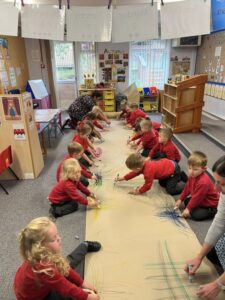
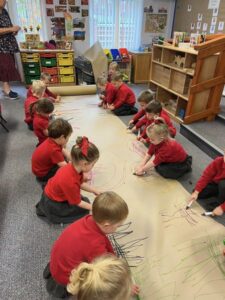
From EY2, the children then begin to learn the correct letter formations and how letters are presented on lines. There are still lots of practical activities with a drive to more formal lessons towards the end of EY2 preparing children for transition into KS1. The children need to be secure in all letter formations and be consistent in their presentation before moving onto first joins and joining letters together in Y2.
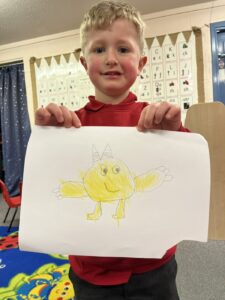
Drawing Club, developed by Greg Bottrill, is an immersive EYFS approach focusing on imagination, language, and mark-making through stories and animations. Based on the “3M” principle—Making Conversation, Mark Making, and Mathematics—it uses a weekly “portal” story to engage children in daily character, setting, and “Adventure Time” activities. The children In EY2 have really enjoyed the new approach and already we can see the benefits of adopting this club into our weekly writing sessions.
-
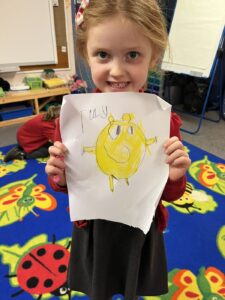
- Nibbles, created in the writing area
-
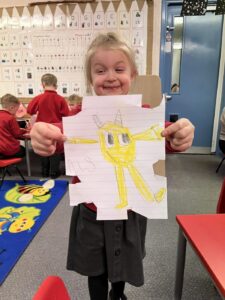
- Nibbles has chewed my paper!
-
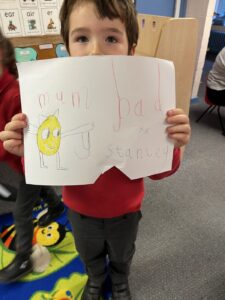
- Letter formation
At Netherton the children begin to understand spelling patterns, sound families and alternative sounds in their daily phonic sessions. This information is on our reading page. Carefully planned lessons ensure that these particular high frequency words and tricky words are embedded into each lesson enabling the children to start applying their phonic sessions in their written and mark making lessons.
At Netherton all our display walls reflect the needs of all pupils. Displays with tricky words, sound families and topic vocabulary feature prominently, so the children can independently find what they need to help them spell words correctly. Early Years 2 through to Year 2 have the frieze frame and grow the sound displays that are key to the Little Wandle scheme. Children can use these working walls and spelling patterns once they have mastered the oral composition and are ready to start writing their simple sentences.
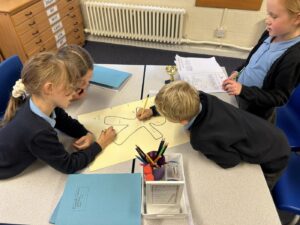
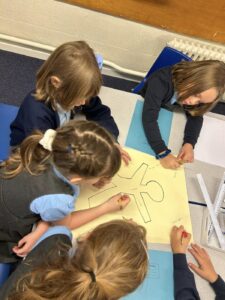
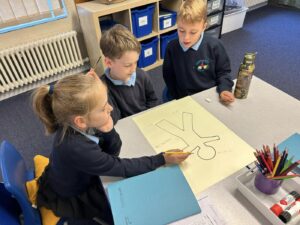
Once children have secured oral composition, they will move on to written composition and throughout KS1 will move between the recommended stages of writing. The process is not linear and children will move back and forth between the phases before sharing their writing.
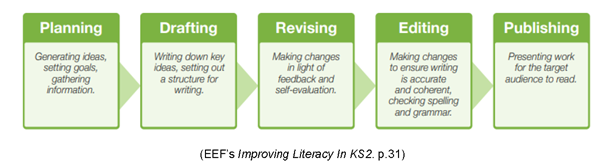
This writing process is then repeated throughout KS2 with more emphasis on composition than transcription as spelling rules and handwriting should be embedded by KS1. Children will still be encouraged to use oral composition before writing sentences down and this will take part in the planning and drafting sections, especially in Lower Key Stage 2. To further develop transcription across school, we have adopted a new spelling scheme.
 New Program adopted this October 2025! Cracking Spelling
https://crackingenglish.co.uk/cracking-spelling
All staff at Netherton have recently taken on a new scheme for spelling called Cracking Spelling. Staff are using the new program to better equip our pupils with the spelling patterns and rules they need to become confident writers.
This Cracking Spelling program is designed to support and guide staff in delivering the spelling expectations from the National Curriculum through years 1 – 6. It is a prescriptive program that focuses on ensuring children develop an investigative approach to spelling. All the Cracking Spelling programs align with the expectations outlined in the DFE Writing framework, ensuring it develops children’s understanding of words through phonemic awareness, orthography understanding, morphology and, where appropriate, the etymology of words, providing children with a deeper understanding of word structures. Within the program, there is also the focus on the grammar understanding of the words that are the focus of the sessions.
Please find below and a number of resources that can further support your child with home learning.
new-curriculum-spellings-for-year-1-and-2
statutory-spellings-year-5-and-6-word-mat
statutory-spellings-years-3-and-4-word-mat-

The teaching of spelling, punctuation and grammar skills is woven into the writing lessons, in order to ensure that the children are applying their SPAG skills appropriately. Punctuation and grammar skills are taught in a logical, progressive sequence within each year group. Teachers use the punctuation and grammar progression map as a tool to plan writing outcomes that will lend themselves well to the writing skill that they intend for the children to develop. At Netherton, we know the value of excellent vocabulary, and this is developed and practiced across our English curriculum with display of ‘Word of the Week’ and the use of our own pupil vocabulary books. These books enable our pupils to build a rich diet of vocabulary they have used an applied in previous sessions and topics, allowing the vocabulary to become embedded and used appropriately. Each classroom has an EGSP working wall which children actively use to support their independent learning.
The Children at Netherton are encouraged at every opportunity to challenge and improve and this success can be rewarded a number of ways. We promote the importance of written work and enable children to see themselves as authors and poets, by displaying good examples of writing in every classroom and on corridor displays. We hold very important theme days that children can excel as ambitious authors and progress can be seen from our brilliant EYFS pupils right up through to our Year 6 Superstars. The showcasing of these whole school writing days can be seen throughout the school and are also shown on our other media platforms. A visit to the Headteacher is always a treat! Followed by that all important message home to parents so they too can praise and reward. Team points and stickers give a big smile so other adults around the school can ask them why they are wearing that sticker with pride.
Please find below long term plans for all year groups.
The-writing-plan-for-Netherton-EY2-25-26
Y1-English-Long-term-plan-Netherton-25 26
EnglishLongtermplanNetherton Y2 25 26
EnglishLongtermplanNetherton-Y3-25 26
English-Long-term-plan-Netherton-Y4 25 26
English-Long-term-plan-Netherton-25 26 English-Long-term-plan-Netherton Y 5 25 26
Please find below our EGSP Long term progression plans for our pupil’s at Netherton.
Impact
At Netherton the impact of our established EGSP curriculum is showcased by displaying clear progression around the classrooms and corridors that surround our school. Children can clearly see their own next steps and identify new ones by having those vital conversations with their peers and teachers around them. Children collect their editing tools as they move up through the school and are clearly confident at drafting, editing and rewriting independently by the end of KS2. Our children are creative writers, who show their passion not only in their writing but also amongst the whole school family.
Data
Pri Profile 2025 – Netherton v1
We are preparing our children to be lifelong writers by ensuring that learning is sustained and that the writing skills that they acquire are transferable and travel with them as they grow and develop beyond their school life. We carefully track progress and attainment throughout the year and look at the impact of our teaching and resources, along with our governing body, to ensure the children at Netherton receive excellent, quality and high impacting teaching.
What can you do at home to help.
-
Get talking – getting children to express themselves in conversation is fantastic practice for expressing themselves in writing. Conversation allows children to learn new ideas, vocabulary and grammar. After trying out new language while talking, children are better prepared to use it in their writing.
-
Read aloud to your child whatever their age. Reading to your child exposes them to new vocabulary, ideas and worlds which will transform their writing.
-
Find opportunities for your child to write for different purposes, for example, a letter or email to grandparents, shopping lists, recipes, little notes, greeting cards, making little books and stories and keeping a diary.
-
Celebrate your child’s work and achievements at every possible chance. Promote taking pride in their work.